Ammonite

Ammonite

Tuesday, May 15, 2012

Foucault's Pendulum

Foucault's Pendulum in Griffith Observatory
In the main entrance to the Griffith Observatory is a Foucault's Pendulum. Besides being the title to a complex and fantastic book by Umberto Eco, a Foucault's Pendulum is a tool invented by Jean Bernard Leon Foucault to demonstrate the rotation of the earth. The original, (proving to the world once and for all that the earth does indeed spin) is hanging in the Pantheon in Paris. (It was on my list of things to see this past trip to France, but I missed it because we didn't have enough time.)
Anyway, how it works is that a heavy ball is suspended from a cable which is attached to the ceiling about 30-35 feet up. The cable is hung in such a way that keeps the pendulum form getting twisted up. Thus it can swing back and forth without experiencing a spinning component, or any additional forces. When one views the pendulum swinging over the floor (often numbered like a clock) it appears as though it is moving clockwise over the floor as it swings back and forth. BUT what is really happening is that the floor is spinning beneath the pendulum which is swinging back and forth tracing the exact same arc over and over!
You might be wondering how we could know that it's the earth turning and not the pendulum? Well, depending on where on the earth you set it up, the pendulum and it's rotation will change, and it does so in a calculable and predictable way. At the north pole the floor will make a 360 degree rotation in a day, the farther south you go (or north from the south pole) the less complete the rotation will be. At the latitude of San Francisco the floor rotates about 220 degrees. At the equator it doesn't appear to rotate at all. (This is because there are two components of motion one is rotating around a center (like a spinning ice skater), and the other is like riding along in a great circle (like two dancers waltzing around a giant circle) The combination if these forces determines the motion of the floor beneath the pendulum. Thus it is demonstrated that the earth is turning, and not the pendulum itself. Cool stuff hu?


The Griffith Observatory

The Griffith Observatory
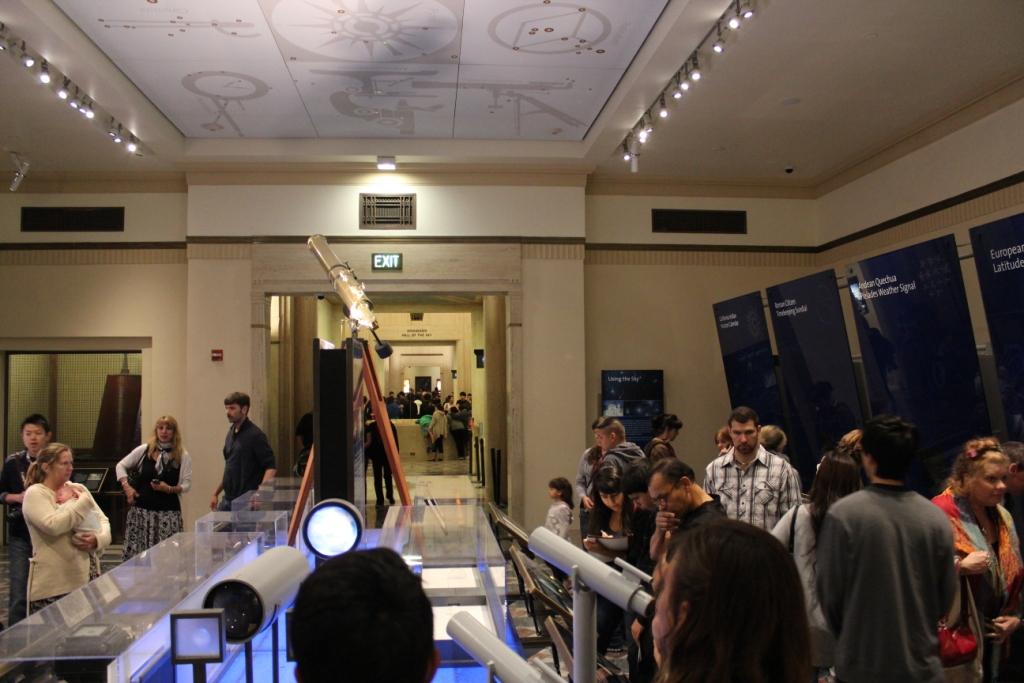
Over last weekend, part of my family, my BF and I went up to the Griffith Observatory to have a look around. Built on the south slope of Mount Hollywood on land donated to the city by one Col. Griffith J. Griffith (ha ha), it officially opened it's doors in 1935 and has been an LA attraction ever since.
We went at about 9:00 pm on a Saturday night and the place was packed! There were people everywhere! And with good reason. Not only are the views of the city spectacular, but there is also a fantastic (free!) museum inside that has all sorts of great space related fun stuff. From real meteors to scales revealing your weight on all of the 9 planets...I mean 8 planets and 1 "dwarf planet" (i.e.Pluto), there is something interesting for everyone!
Of course I snapped a few pictures along the way;) Take a look! And if you are ever in the LA area, I highly recommend this as an early evening/ nighttime "must-see"! I bet it would be beautiful at sunset...

View of LA from Observatory

LA nighttime.

Me and sign


Crystals and fossils...Awesome!

All about telescopes!

How it works

This kind of telescope discovered the moons of Jupiter!

Self portrait in thermal camera. 

Earth can be seen in the upper left between the rings!


Ouch!

Saturn and it's rings. Main exhibit Hall

My buddy Einstein and I.

My weight on Pluto. Yesss!

La Lune

Blame Neil DeGrasse Tyson;)


Monday, May 14, 2012

Now That's Power!

I was just looking through my notes on particle physics and came a cross a paragraph I'd highlighted, and thought it was interesting enough to re-type here. It is addressing the reason why (remember we are talking about physics here) antimatter is so interesting not only to science, but also to science fiction writers. (If you recall the U.S.S. Enterprise is powered by antimatter;) The last bit is the most interesting. I had no idea how almost totally inefficient all our methods of producing energy are...

"The glamorous nature of antimatter has given rise to the science fiction notion that it may solve the energy crisis. Indeed, a kilogram (2.2 pounds) of antimatter would provide enough energy to keep the United States going for a day. This is because the entire mass of the antiproton (plus the proton it takes with it to total anihilation) is converted to energy via E=mc2. In the burning of coal or oil only one billionth of the mass is converted to energy. In fission reactors this number is 0.1 percent, and the long -awaited fusion energy supply (don't hold your breath!) it is about0.5 percent."

Taken form The God Particle by Leon Lederman.

I-5 Southbound

Many people find the drive along I-5 through the San Joaquin Valley of central California to be long and tedious. And while it's true that there isn't much in the way of towns or people along the route, I still think it is a beautiful drive, and find that I really enjoy it the couple times a year I find myself on it. Of course I wasn't the one driving since I was too busy taking pictures, so I am sure that makes a difference, but I have always thought the Central Valley is beautiful in a distinctly California way. From the orchards, to the treeless hills, it's got a very no-nonsense, salt-of-the earth, home-grown kind of feel to it. And I love the different looks it has depending on the time of day. From cool and clear to sweltering and hazy and all the angles of light and shadows in between, the landscape takes on hues and "personalities" that are somehow comforting and quaint, while at the same time picturesque and charming. The sun both ascends and descends into the mountains that flank the valley. In the morning as it rises it is a celebration of a new adventure. In the evening when it sets it is a much anticipated relief from the dry dusty wind, and the blazing heat.
Here is the first set of photo's from my trip southbound. So come take a ride along the I-5 with me! 

Eastbound 152

San Luis Reservoir

The Sierra Nevada Mountains

Sunrise over the Sierra

Morning arrives in the San Joaquin Valley!

My favorite grassy hills

Fields and hills

Classic valley scene

Baby trees!

Wine spheres...I mean grapes:)

Erosional gully

Orchards

Sheeps!

Hey, it's hay!

More vineyards

Grassy field of happy cows.

Thursday, May 10, 2012

Road Trip!

Tomorrow I am headed down to SoCal (southern California for all you non-Californians;) for my middle-little brothers graduation from USC! He is receiving his masters in Astronautics and I couldn't be a prouder sister! I have spent the afternoon frantically trying to get all the last minute things done before I leave. This included getting my hair trimmed (which cost $17. It was supposed to be $15 but the woman explained that they had to charge me more because I had too much hair...I don't know if that was fair, but I paid it.) I also washed the cooler, cleaned my car (but we've decided to take the truck), packed, did laundry, watered all my plants and...well, you get the picture. I made time to sneak in a run at the gym too! Oh, and I stopped an Noah's Bagels to pick up some for breakfast since we are leaving at 4:30 am, and nothing will be open. The store was just closing so the cashier gave me a whole bunch for free! Too bad carbs and I are no longer friends:/ I'll take them with me and share though.
When I was out on the patio washing the cooler I saw a little black and brown bird that I have noticed out there before. It has a panic attack every time I step foot on the patio these days. It pretends to be wounded and makes a little clicking sound, kind of like a *tisk* and flops all over the place. I realize that it is probably nesting in one of my spider plants, and trying to distract me from it's eggs.  I have tried to tell it to relax, that I have no interest in it's eggs, but it doesn't understand me. And I can't avoid my patio for the next month or two while the eggs hatch and the chicks learn to fly...but I still feel bad. I don't want the mother/father to have a coronary before the babies are born!
I have sort of a love/hate relationship with all the creatures that live on my patio. The little grey rolly-polly bugs that look like miniature trilobites (don't know what they are called) seem to have their annual spring fling out there, and are everywhere, scurrying for cover whenever I lift anything off the ground, and contracting into tiny spheres when I sweep.
And then there are the snails...They eat all my plants...Well, actually that's not entirely true. They totally eat a few, and with the rest they just take a couple bites out of every single leaf. Grrrr....I tried to kill them last summer by drowning them in beer (it was the only humane option I came across, and I thought to myself if I had to go, I'd probably not be too upset if it was in a pool of beer;) but they thwarted me, or reproduced before taking a swan dive into the Miller Light and it was all for naught.
I have pretty much given up at this point because I realize that they are just doing what they are made to do, and it's not their fault if I have the most lovely, well watered, delicious snail snack filled patio ever.
But I digress. Anyway most of my "to do" list is done, and tomorrow I will be embarking on a road trip down the illustrious (joking) I-5 to Pasadena! So long!

Wednesday, May 9, 2012

Assembling California


This months selection for book club was Assembling California by John McPhee. You may recall that he also wrote Basin and Range. I think he is a really great writer, and despite the book being somewhat outdated, it is pretty good. Any volume on geology that can contain the words pluton, xenolith, and ophiolite, and still be interesting to the average reader is truly a treasure. Trust me I know;) McPhee mixes it up by talking a little geology, and then inserting a slightly irrelevant, but none-the-less interesting topic like the names of mining towns, or a childhood history, before going back to the geology at hand.
I also appreciate the way he chose only a few aspects of California's geologic history to focus on, letting others pass unexplained. There is just too much to say about the geology here to write an inclusive book intended for the general populace. So I am glad he didn't try. It would have ended up confusing and uninteresting. I believe his strategy was similar to the one I had for the lab classes I taught. I kept it simple, picked things that were a.) exciting, b.) not to difficult to understand, and 3.) inspiring.
The book is organized so the reader accompanies McPhee from eastern California (at the latitude of Lake Tahoe along Interstate 80) to the western coast. As he hops from outcrop to out crop, road cut to road cut, he jumps back and forth in time as well. He might be inspecting an ophiolite sequence in the present, then switch to describing it as it would have been millions of years ago, and miles from it's present location. Then he moves back up in time, but not quite to the modern day, and tells a story about an old 49er (in 1849) named Jim-Bob who had a placer mine just down the slope. In that way he weaves geologic time with historical time, and manages to tell a pretty good story.
Reading on a bench outside the library.
It's also a pretty great historical text because most of the people he interviewed for his book (and much of the commentary) revolve around the "newly" accepted theory of plate tectonics. I sometimes forget that it was only in the 1960's that plate tectonics theory was developed. Up until then geology had been stuck in a rut with several unsatisfying hypotheses for the formation of mountains and the like. As McPhee points out, there are marine fossils on the top of Mount Everest, the highest mountain in the world. For a long time no one could explain how they got there. Plate tectonics changed all that.
I also thought it was interesting to learn that the origin of the state was from a story written in the 1500's by a Spaniard, about an island called California (after their Queen Califia) full of black amazon women with gold weapons and armor, who ate men and male babies and flew on griffins;)  I think it's at least partly fitting since California is a collection of island arcs accreted onto the western coast of North America, and because there is so much gold here. I tried to find a copy of the story, but to no avail. The best I could get was the summary from wikipedia. It's an interesting read though.
Anyway, it was an excellent book, and I highly recommend it to anyone interested in the geology of California, geology in general, or the mining towns in the western foothills of the Sierra.

Santa Cruz