Ammonite

Ammonite
Showing posts with label Geology. Show all posts

Wednesday, August 29, 2012

The Story of the Earth


My mom got me a couple really neat old books. One was written by T.H. Huxley aka "Darwin's Bulldog", and the other by a geology professor from The King's College in London called "The Story of the Earth". The latter was written and published in 1895. Quite an interesting read!
Being a post-tectonics geologist, it is almost impossible for me to comprehend what geology was before anyone knew that the crust of the earth was broken up into plates and moved around forming mountain chains and building and breaking apart continents. I mean how else can you explain the Himalayas?
In some ways the geologists of 100 years ago understood our field so well, to the point that their "laws" of original horizontality, cross cutting, and uniformity are still true today.
But then I read about their explanation for how mountain chains form, or the mechanisms for deformation and I'm struck by how wrong they were. (Not that I think this is a fault of theirs. Certainly not. They were doing the best they could with the information and technology they had.) They cited everything from shrinking and expanding rock (somehow due to infiltration of water) to tides to explain volcanoes and mountain building!
It's amazing that geology has come so far so quickly. And I am glad I got to be in on it on this side of the "Tectonic Revolution". It's been really neat to look at a subject I love so dearly through they eyes of an expert in the field that lived over one hundred years ago. It's may not be scientifically accurate, but it's still such an enlightening window into my chosen field. It's an early chapter from a story about a group of scientists searching for the truth about the earth. Maybe they didn't quite make it there in 1895, but those that came after them kept searching, and thinking and trying, and eventually they (we) figured it out. As Newton (Sir Issac, not Wayne or Cam) famously said "If I have seen further, it is by standing on the shoulders of giants."

Wednesday, June 6, 2012

Thin Sections

Thin Section
Have you ever wondered what a rock would look like if you cut it into really thin slices and then inspected it under a microscope using polarized light? Well stop wondering and take a look! These are photo's I took of thin sections I had made of rocks in my field area. I was looking for evidence of chemical assimilation of....well, actually it doesn't really matter. Most of the rocks are quartz monzonites (like granite but with less quartz), and  gneisses (black and white striped metamorphic rock).


Wednesday, May 9, 2012

Assembling California


This months selection for book club was Assembling California by John McPhee. You may recall that he also wrote Basin and Range. I think he is a really great writer, and despite the book being somewhat outdated, it is pretty good. Any volume on geology that can contain the words pluton, xenolith, and ophiolite, and still be interesting to the average reader is truly a treasure. Trust me I know;) McPhee mixes it up by talking a little geology, and then inserting a slightly irrelevant, but none-the-less interesting topic like the names of mining towns, or a childhood history, before going back to the geology at hand.
I also appreciate the way he chose only a few aspects of California's geologic history to focus on, letting others pass unexplained. There is just too much to say about the geology here to write an inclusive book intended for the general populace. So I am glad he didn't try. It would have ended up confusing and uninteresting. I believe his strategy was similar to the one I had for the lab classes I taught. I kept it simple, picked things that were a.) exciting, b.) not to difficult to understand, and 3.) inspiring.
The book is organized so the reader accompanies McPhee from eastern California (at the latitude of Lake Tahoe along Interstate 80) to the western coast. As he hops from outcrop to out crop, road cut to road cut, he jumps back and forth in time as well. He might be inspecting an ophiolite sequence in the present, then switch to describing it as it would have been millions of years ago, and miles from it's present location. Then he moves back up in time, but not quite to the modern day, and tells a story about an old 49er (in 1849) named Jim-Bob who had a placer mine just down the slope. In that way he weaves geologic time with historical time, and manages to tell a pretty good story.
Reading on a bench outside the library.
It's also a pretty great historical text because most of the people he interviewed for his book (and much of the commentary) revolve around the "newly" accepted theory of plate tectonics. I sometimes forget that it was only in the 1960's that plate tectonics theory was developed. Up until then geology had been stuck in a rut with several unsatisfying hypotheses for the formation of mountains and the like. As McPhee points out, there are marine fossils on the top of Mount Everest, the highest mountain in the world. For a long time no one could explain how they got there. Plate tectonics changed all that.
I also thought it was interesting to learn that the origin of the state was from a story written in the 1500's by a Spaniard, about an island called California (after their Queen Califia) full of black amazon women with gold weapons and armor, who ate men and male babies and flew on griffins;)  I think it's at least partly fitting since California is a collection of island arcs accreted onto the western coast of North America, and because there is so much gold here. I tried to find a copy of the story, but to no avail. The best I could get was the summary from wikipedia. It's an interesting read though.
Anyway, it was an excellent book, and I highly recommend it to anyone interested in the geology of California, geology in general, or the mining towns in the western foothills of the Sierra.

Definition: Palinspastic

Reading rocks.

Palinspastic: Showing the previous location of geologic features, correcting for any intervening crustal movements.


Basically it is a term used in geology, and it means taking an outcrop and (in your mind) working your way backward through the deformation and time to see the individual units in their original depositional environments.
It's kind of like only having the last page of a story and trying to figure out how, and where it began by using clues embedded within the text.
It's one of my favorite things to do, untangle the history of rocks. It makes me feel a little like James Hutton (Father of Geology) and a little like Nancy Drew (teenage supersleuth;)

Wednesday, April 18, 2012

Geophysics

Here are a couple shots of me "in the field" laying down lines for some geophysics that I was helping my boss out with a while back. We were up in the Sierra, and we had to camp out because it was in the middle of nowhere. It was a lot of work, but totally fun!


Tuesday, January 17, 2012

FINALLY Finished!

Dropping off my signed thesis!
Well, it only took five years, but I finally finished my thesis! I'd like to say it was a great experience (and the actual field work was) but mostly it was frustrating and exasperating. I felt the pressure to get it done, but most of the time I was helpless to make it go faster. I was stuck between a rock and a hard place as it were. No pun intended. But it's done, it's over, and I have a Masters Degree in Geology. I wish I felt happy about it, but at the moment all I feel is relieved. So...wheeew.
What was my thesis title?
Incorporation of Host Rock Blocks During the Growth of the Aztec Wash Pluton, Eldorado Mountains, Nevada.
The final FINAL document!
What was it about?
How magma bodies move through the crust, specifically whether or not they utilize the mechanism of stoping (downward transfer of host rocks through a magma chamber), and whether there was geochemical evidence of assimilation of blocks in the Aztec Wash pluton specifically.
Is there anything else you need to know about it?
Nope.

Wednesday, January 11, 2012

Google Rocks

I love the Google homepage logo for today! It's not often that you see geology incorporated into internet art. Curious about what inspired the geo-drawing I did a little research, and found out that today is the 374th birthday of Nicholas Steno the founding father of the geological sciences.
Back in the 1600's in addition to realizing that fossils were the remains of animals that no longer existed (I guess at the time people thought they were left over from the flood?), he also discovered the three of the primary laws of geology which remains uncontested today.
The law of original horizontality states that all sedimentary rock layers originally form horizontally, and are only tilted later. The law of superposition states that the material in the lowest layer is older than the material in the upper layers. And the law of discontinuity states that if one object or rock layer cuts another than the layer that is cut is older than the one doing the cutting.
So, thanks Nick for all your great observations and starting my specific branch of science! You rock! (ha ha get it?)

Thursday, April 14, 2011

Carolinapectin jamieae


I was just reminded of the fact that years ago as an undergraduate I used to go fossil shell hunting in the quarries out in Loxahatchee Florida. I even found a holotype, (the first specimen of a new species ever discovered) once! Of course I had no idea that it was a new species, it took my professor to discover the fact. And obviously I gave it to him because it was his research that allowed me to go there collecting in the first place. He told me he would name it after me, and said that I could look it up in his next book when it was done. Only I moved away and never actually looked for it. Anyway I just did an internet search. His book is too expensive to buy it turns out (125.00!), but as luck would have it the part about my shell was one of the pages you could preview on Amazon! Woo Hoo! Unfortunately I was unable to see the page that had a photograph of the shell though. It basically looks like a big grey scallop shell. Anyway, here is the page documenting my small contribution to paleontology/paleomalacology!


As sort of a side note, it's interesting how perspectives change with age. When I lived in Florida and was going to school, and fossil hunting in the quarry, and scuba diving with my professors I assumed that my whole life would be like that, like it was just the beginning of the adventure. But from where I am now, it appears that WAS the adventure. And probably the happiest time in my life. But...well, we all have to live with the choices we make. And you can never really go back. LOL. Not to sound too negative. Besides who knows? Maybe there is still an adventure out there with my name on it, just waiting for me.

Saturday, March 12, 2011

Japan Quake

Today is my day for posting about geology! But I wanted to write one more quick blog about the earthquake in Japan a couple days ago, and some thoughts I have about it as a geologist.

I think that everyone should make the attempt to learn at least a little about geology. Even if you aren't into the romantic aspects of it, there are many practical applications. Most people think "what's there to know about rocks?" but then you have something like the 8.9 earthquake in Japan, and suddenly it seems pretty important. Everyone was wondering how an earthquake causes a tsunami, ( and some wondered if the tsunami makes it's way to California would it cause earthquakes here!)
A lot of people here, on the West Coast, could have been spared the terror of believing something straight out of movies like 2012 was going to occur if they had just the smallest understanding of geology. For example people along the California coast were freaking out and racing for higher ground early this morning in their pajamas when the tsunami wave was just about reaching Hawaii, a full six or seven hours before it was likely to reach here. (Actually I don't have a problem with evacuating as an extra precaution, it was probably a good idea. It's just that people were doing it terrified that they would be engulfed in a 200' high wall of water if they didn't move now.) And that is totally ridiculous. They panicked and scared the crap out of themselves for no reason. They imagined California being wiped off the map. Knowing about geology, topography, and that the Pacific Ocean is pretty freaking huge, I predicted that at worst there would be some flooding around the bay, and some damage to boats in the marinas, and maybe the loss of some waterfront property.
I bet the people who were sitting in their cars on the side of mountain roads, imagining their homes being washed away and settling to the bottom of the dark ocean (with all their family pictures and heirlooms) would have appreciated knowing that the possibility of that happening was almost zero.

Another interesting thing to think about from a geologic perspective is that because of the news, and the videos of the devastation, many people probably don't realize how much worse the damage and death toll would have been if it had occurred anywhere else in the world. Most people don't realize that Japan is prepared for an event like this (well, as prepared as anyone can be for a natural disaster), that they have the strictest building codes in the world, and that hundreds of thousands of lives were spared two days ago because of a combined effort (over several decades) of geologist, geotechnical engineers, engineering geologist, and civil engineers. These people  found ways to design buildings that don't collapse around workers and families during earthquakes through an understanding of geology, plate tectonics and engineering. It's hard to count how many people aren't dead that should have been if not for the meticulous building codes, but I'd guess the number would be in the tens of thousands.
The earthquake and tsunami are a horrible disaster for the Japanese people to be sure (and the nuclear power plant situation is worrying) but it could have been a lot worse. And we have an understanding of geology (and other sciences) to thank for that!

Basin and Range

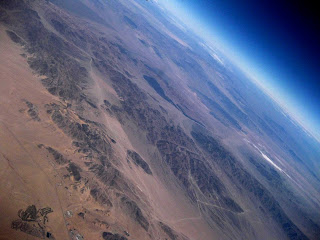
The Basin and Range from 20,000 feet. (Photo by me.)
It occurred to me while flying somewhere over the Basin and Range, that I haven't posted many blogs about my given field of study. I decided then, as we sailed over dry lake beds and faulted earth that I would re-read Basin and Range by John McPhee and write about my favorite geological province. McPhee's is an older book, first written in 1980 I think, but one of the best in expressing the wonder of geologyof the western US.

He makes fun of the names and terminology while trying to explain them, paints vivid pictures of landscapes long gone, and explains the history of geology and it's methods without boring the reader to death. It's really a great read, and I highly recommend it to anyone who has even the slightest curiosity about how geology works, and why it's so interesting.
I also though it was a good time to post something about geology because of the earthquake that occurred off the coast of Japan a couple days ago, that caused the tsunami that devastated much of northern Japan.
It seems to me anyway that most people have a general knowledge about other sciences namely ones that affect them directly. Take biology for example, most people know that we have DNA and genes that explain things like hereditary disease. Or astronomy, that the sun is the center of our solar system, and the length of the day is decided by the spin of the earth. Meteorology is another science that the average Joe knows something about.
But geology, because it's implications are so non-important to the live of the average person (except maybe here in California), has almost no identifiable base of understanding in popular society. If I speak about rock less that 10,000,000 year old as being  "young" or oceans that existed two hundred million years ago people look at me like I am crazy. When I explain that the San Andreas fault is the boundary between two tectonic plates moving in different directions people are amazed. When I say something to the effect that one would never (under any circumstance known on earth) find fossils of dinosaurs in granite, I get doubtful glances, and questions like "How could you know that? You haven't seen every rock on the planet. I'm sure there is a granite somewhere with a Tyrannosaurus bone in it." There is no solid base for which a lay person can even begin to construct the rational geologist use to make their discoveries, establish their facts, or see the world as it existed at a time when there were no humans around to see it.

It's too bad too because I can tell you from personal experience the paradigm that comes from viewing of the earth as a geologist is one of the most rewarding and exhilarating feelings I have ever had as a scientist.
I am not sure how many people (over the age of 5 anyway) still look out the window of an airplane as it flies thousands of feet above the earth, but I do. Always. Unless there are clouds or it's dark, my eyes are glued to the terrain below. Viewed only as shapes and colors the surface of the earth is breathtaking. But looking at jagged mountains, iron stained valleys, ribbons of bedrock that appear to have been cut and pulled apart by a giant pair of scissors, ridges tilted upward to the sky and halved by rivers that curl almost back on themselves, the red of oxidized sandstone and the black of basalt flows out of small cinder cone volcanoes, and understanding the processes that made it all is just...mind blowing.
I can look out the window and see continents colliding, mountains growing, racing toward the sky, the earth being stretch and pulled apart, tiny volcanoes erupting like black pimples across smooth gray-tan sediments of bowl shaped valleys. I see oceans where there are now deserts, I see sand dunes where there are now mountains. I see what was once millions of years of quiet marine strata, violently split apart and jostled into near vertical positions. Not only can I see these events, I can also tell the order in which they occurred (although not the specific time in years.) Take this example from McPhee where he was discussing a road cut along the highway
"In order to account for that hillside...you had to build a mountain range, destroy it, and then build another mountain range in the same place, and then for the most part destroy them."
One of the greatest qualities a geologist possesses is the ability to see what is no longer there.

If I see low smooth mountains with exposed strata flanked by a shallow valley dotted with cinder cone volcanoes and tiny roads cutting through the dark basalt I can piece together a story with a beginning middle and end. It will probably span a hundred million years and go something like this:
Way back when, there was an ocean that over millions of years deposited sediment horizontally on its bottom where it hardened into rock. Then something occurred, (maybe colliding plates, maybe a pulling apart of the earths crust...who knows?) that caused the ocean to disappear, and several large lakes to form between the exposed layers rock that were broken apart into fresh sharp pieces and tilted  this way and that. Then over another long time time the sharp ridges were dulled by wind erosion and rain. As the valley filled and the lakes evaporated, the mountains became low islands in a sea of sediment. Sometime later the earth was stretched (ah ha! so the mountains formed by stretching, not by collision!) a little more, became thinner and small basaltic (the kind in Hawaii that get their "juice" from the molten material under the rigid crust) cinder cone volcanoes squirted through the weak areas, where the crust of the earth was thinnest, and where the magma below was closest to the surface. Then later on (probably a few million years) human beings came across the mountains turned to hills with bulldozers and concrete and blasted a road through the extinct volcanoes, and over the gently sloping hills and valleys to connect the dozens of small desert towns that lay scattered across the landscape. The end.
It may seem unlikely that a person could tell all of that by looking out the window at a bunch of mountains, but when you understand the principles of geology, it is obvious in the rock, in the topography that the story I just told you (more or less anyway) is exactly how the Basin and Range formed, over several million years.
John McPhee describes the Basin and Range as "a soundless immensity with mountains in it" and in those silent mountains is a story which only geologist hear and appreciate. If I could impart any aspect of geology to the non-geologist it would be the ability to look at a mountain, or a layer of stratified rock and be able to read the story in it. That's what makes geology cool. It's finding clues in outcrops of rock, and knowing how to extrapolate back from the piece of siltstone in your hand to the bottom of the ocean it formed in several million years ago. McPhee says it perfectly by saying
"Geologist...inhabit scenes that no one ever saw...scenes gone and gone again....including seas, mountains, rivers and forests...and archipelagos of aching beauty...If some fragment has remained in the crust [of the earth] somewhere and something has lifted that fragment into view, the geologist in his tweed cap goes out with his hammer and his sandwich, his magnifying glass and his imagination, and rebuilds the archipelago."

Monday, August 16, 2010

Geology: My Way


This is a self portrait I took a while back to document my take on being a geologist. Being in a field traditionally occupied by men, I often find it funny that I get the feeling that I should act more "manly" even though that has nothing to do with how well I perform my job. It's expected that I be tough, and capable of handling myself on a construction site (and I am). But when I paint my nails, or wear my Tiffany's jewlery people don't know quite what to do with me. This was my attempt to preserve for posterity my personal view of myself as a geologist: certainly not afraid to get dirty, but not afraid to wear a dress to work either:)
This was taken at our lab where I was pounding out soil samples to get a compaction curve for a job I was working on.

Thursday, May 20, 2010

What's the Difference?


Magma and lava...are they the same thing? The answer is yes and no (and you were worried this would be confusing!) They are physically the same (i.e. they have the same minerals, and are molten etc.) but they do not exist in the same environment. That's the key. That's why there are two words to describe it and not one. Magma refers to molten rock located underground. Think of magma chambers under volcanoes, or super hot melted rock in the mantle that creates "hot spots" like Hawaii or the Galapagos.
As soon as the molten magma reaches the surface however, it is called lava. Lava is expelled from a volcano, and can produce huge flows on the surface. It is molten for a short time, then hardens as it cools. If you are still confused please refer to the above figure for technical details, and further clarification. (Double click on image for larger view.)

Thursday, May 13, 2010

Coming Clean about Pumice

I was just thinking about how unfortunate it is that most people don't know anything about geology. It's a really cool field of science. Part of the reason I think has to do with the fact that most people think geology is sort of useless. They think, what do rocks have to do with me? So instead of writing a novel about how untrue that is, I thought I would instead focus on one type of rock and use it as a small example of how geology impacts our lives.
Pumice. It's a light, porous, rock formed when water rich lava is extruded from volcanoes. Technically it is volcanic glass, like obsidian except with lots and lots of holes in it. When Karakatoa (located in Indonesia) erupted in the late 1800's pumice that formed during the blast actually floated (yep...rocks can float) all the way to the west coast of Africa. (As a side note, Krakatoa by S. Winchester is an amazing book! You should read it.)
So of what use is this to us? Well, you may not know it but pumice is all around us. It is used as landscaping rock (a red type called scoria), and we use it to exfoliate our skin. Pumice is also the main material in the mixture your dentist puts on your teeth during a cleaning that makes them feel smooth and fresh. Pumice is used in many cleaners as an abrasive (things like Soft Scrub etc.), It's sometimes used in cement when the construction projects require lighter weight materials. And it is super useful when placing drunken bets with friends that rocks can in fact float.
So the next time you are getting your teeth cleaned think about the fact that at some point in the past that pumice that is making your teeth all nice and shiny once resided as a liquid in the belly of a volcano. See I told you. Geology is awesome!